%2520(1).png&w=3840&q=75)
2025 was the year cybersecurity stopped being a background concern and became a defining pillar of digital finance, national infrastructure, and the future of the internet itself.
It was also the year the quantum threat moved from theory into the global conversation.
As quantum computing accelerated toward real-world capability, governments, enterprises, and Web3 ecosystems began to confront a shared truth: existing security models were never designed for what comes next.
For Naoris Protocol, this year marked a clear inflection point. What began as a bold architectural thesis evolved into a globally recognized security framework for a post-quantum world. A Sub-Zero Layer designed to embed trust beneath blockchains, enterprises, and critical infrastructure proved not only necessary, but inevitable.
What follows is a look back at the year that validated our vision, expanded our global footprint, and set the foundation for what comes next.
A New Identity for a New Security Era
In 2025, Naoris Protocol articulated its mission with unprecedented clarity: to build the world’s first decentralized, post-quantum security network designed to protect digital systems in real time across Web3, enterprise infrastructure, devices, and AI.
Throughout the year, a series of milestones crystallized this identity.
Naoris reframed cybersecurity from a defensive cost into a foundational trust layer. One intended to underpin digital economies, strengthen national and enterprise infrastructure, and enable quantum-safe innovation without disruption. This narrative resonated far beyond Web3, positioning Naoris as a new infrastructure category rather than a single product or protocol.
Security was no longer treated as something to be added after the fact. It became the foundation being built beneath everything else.
Building an Unbreakable Internet of Trust.
Recognition at the Regulatory Level: A Signal to Washington.
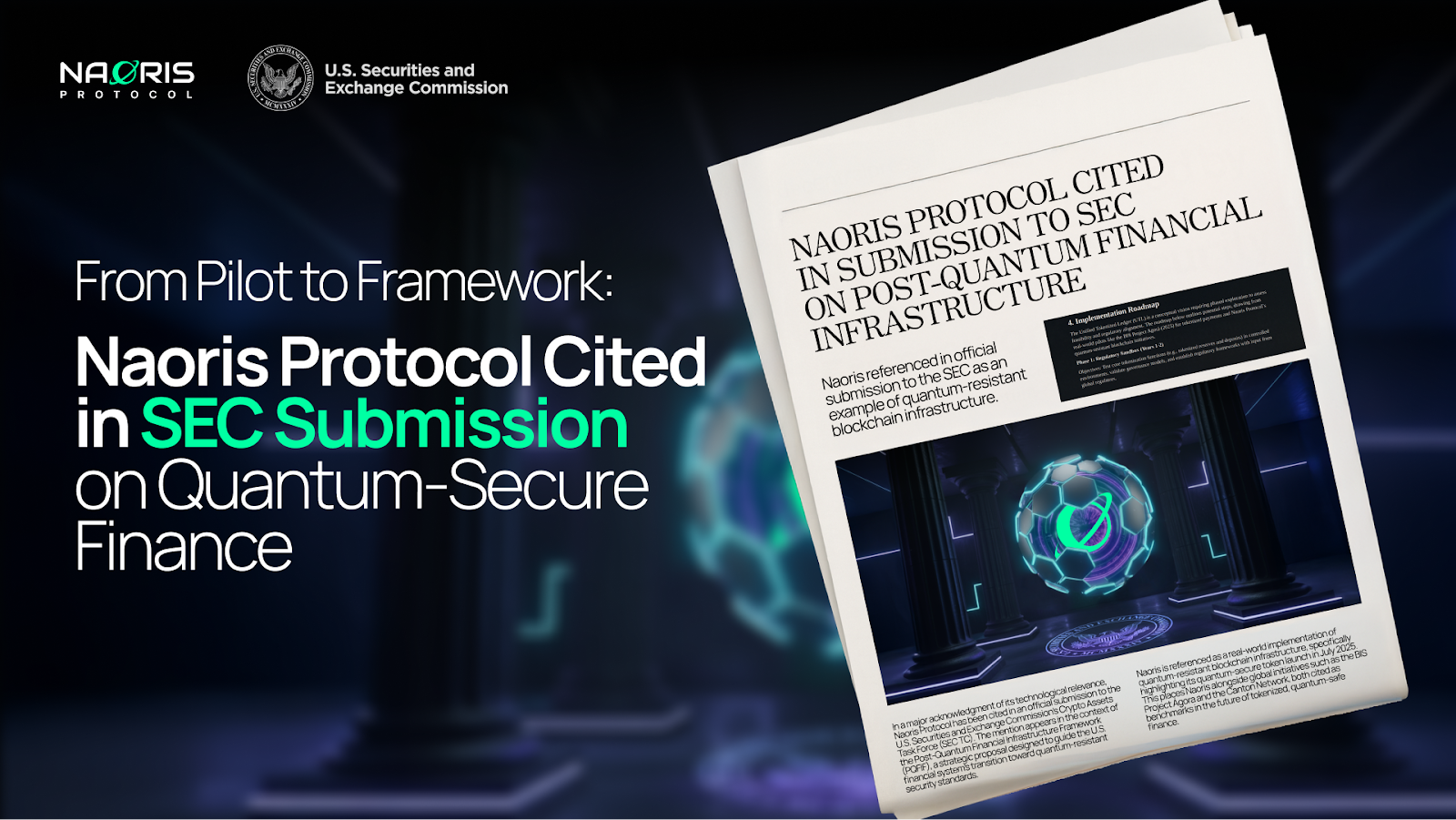
In September 2025, Naoris Protocol was cited in a United States SEC submission as a reference model for quantum-resistant blockchain infrastructure. Appearing on pages 66, 68, and 71 of the Post-Quantum Financial Infrastructure Framework, Naoris was recognized for its architecture and approach to decentralized security.
This marked the first time a decentralized security protocol was referenced as a model for quantum-safe blockchain systems in a US regulatory context. A significant validation of the Sub-Zero Layer concept and its relevance to future financial infrastructure.
It also reflected a broader shift. Regulators are no longer asking whether quantum threats matter. They are asking who is prepared.
Naoris Founder & CEO making media waves
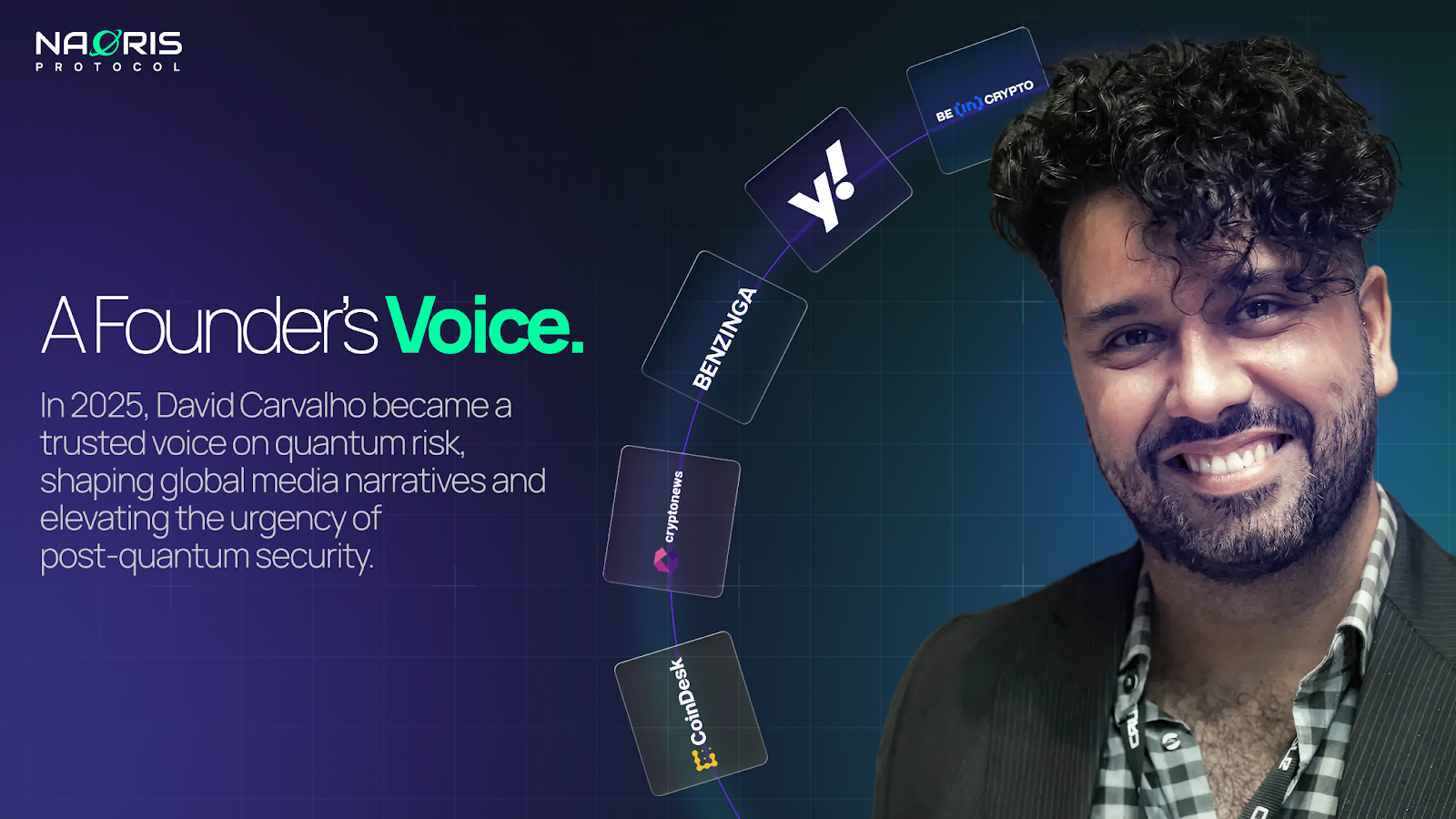
Over the course of 2025, David Carvalho, Founder & CEO of Naoris Protocol, underlined his thought leadership credentials as a prominent voice on the accelerating quantum threat. David penned an exclusive op-ed for CoinDesk entitled ‘Is Crypto Ready for Q-Day?’, sounding the alarm on the imminent threat posed to the industry by quantum computing. He followed that up with another op-ed for Crypto News entitled ‘When Web3 really isn’t Web3’, where he outlined his vision for a more permissionless, sovereign, and decentralized industry landscape. David quickly became the go-to source for a range of highly reputable media outlets and podcasts on topics pertaining to quantum risk timelines and mitigation pathways. At a steady cadence throughout the year, his contributions were highlighted in an exclusive Benzinga article, as well as Yahoo Finance and BeinCrypto. David was also included in the Forbes Uruguay 40 under 40 rating.
A Protocol Built for a Quantum World. Testnet in Numbers:
If the narrative defined who Naoris Protocol is, the technology delivered on that promise.
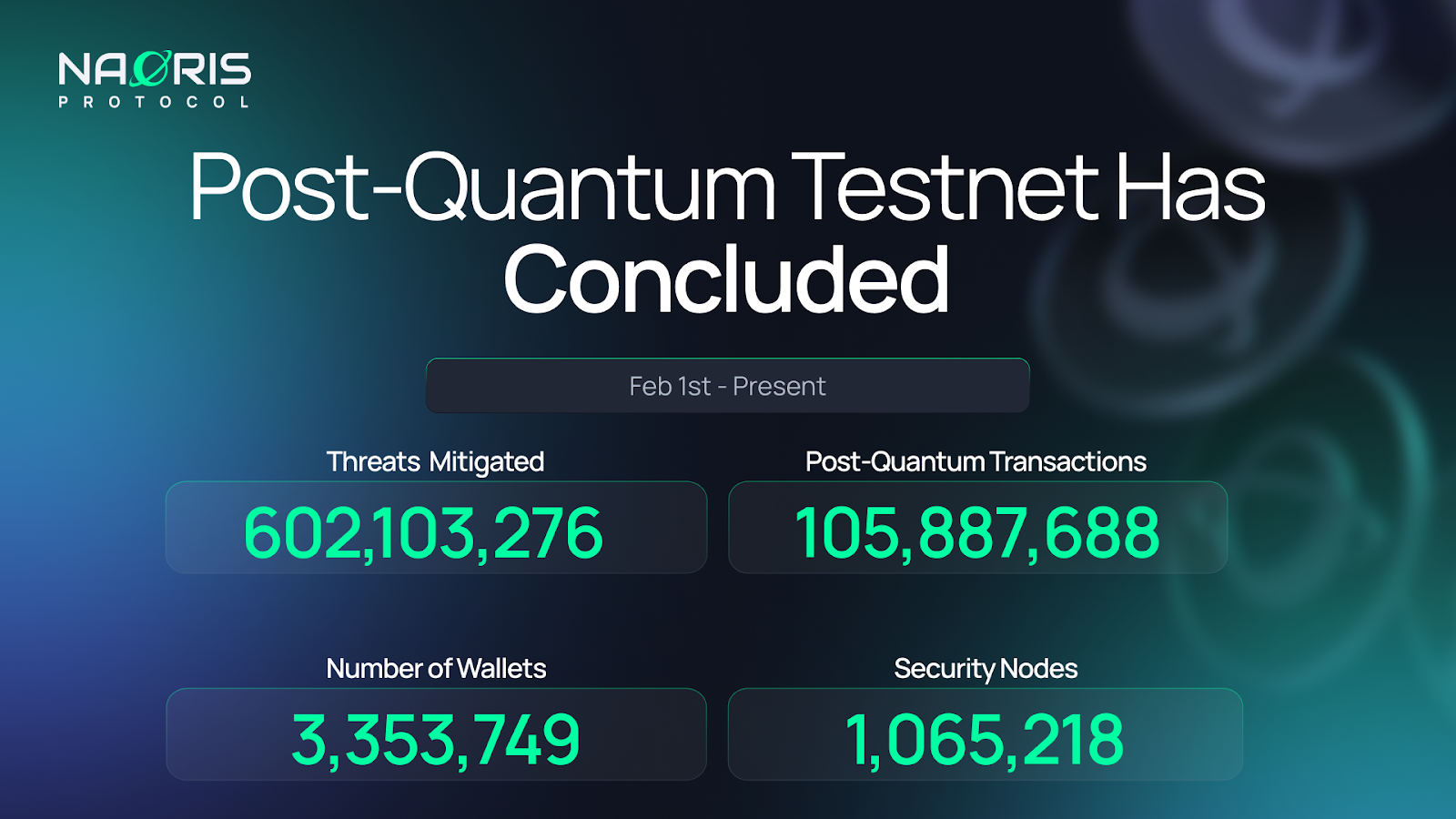
In 2025, Naoris completed its Testnet phase, surpassing critical benchmarks for performance, resilience, and real-time threat mitigation. Over the course of Testnet, the network processed more than 100 million post-quantum secure transactions, supported over 3.3 million wallets, activated more than 1 million validator nodes, and mitigated over 600 million threats in real time.
With Testnet successfully concluded, Naoris entered final Mainnet preparation, targeting launch before the end of Q1. Mainnet unlocks a new phase for the protocol, including developer SDKs, enterprise-grade security tooling, network-level post-quantum enforcement, a dedicated explorer, and the first flagship product to launch post-Mainnet.
Learn more about the Naoris Testnet
Introducing the Sub-Zero Layer: A New Security Category
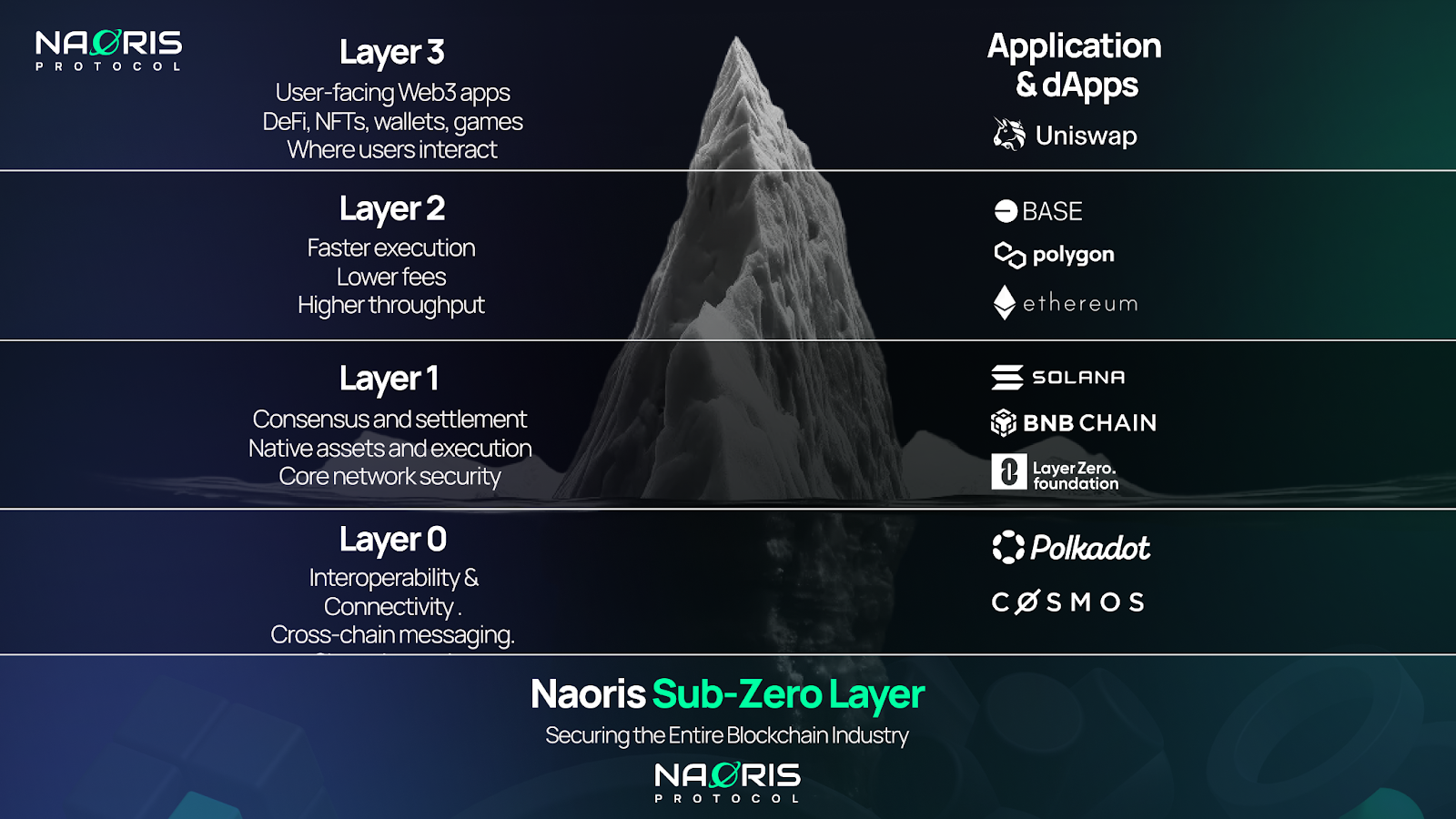
In 2025, Naoris Protocol introduced a new security category to the industry: the Sub-Zero Layer.
Rather than competing with existing blockchains or forcing disruptive upgrades, the Sub-Zero Layer was designed to operate beneath and alongside existing systems. It provides continuous, post-quantum security validation without requiring hard forks, protocol rewrites, or ecosystem fragmentation.
This architecture allows blockchains, applications, and enterprises to inherit quantum-safe protection by design, while preserving full compatibility with existing stacks. Security is embedded at the infrastructure level, not bolted on after deployment.
The Sub-Zero Layer defines how post-quantum trust can extend across the entire digital stack, including Layer 0, Layer 1, and Layer 2 networks, exchanges and custodians, DeFi protocols, AI agents and models, mobile and IoT devices, and enterprise infrastructure.
Once live, the Sub-Zero Layer will represent a fundamental shift in how security is delivered across digital systems, providing the industry with the infrastructure it needs to withstand the accelerating quantum threat.
Security Powered by Distributed AI
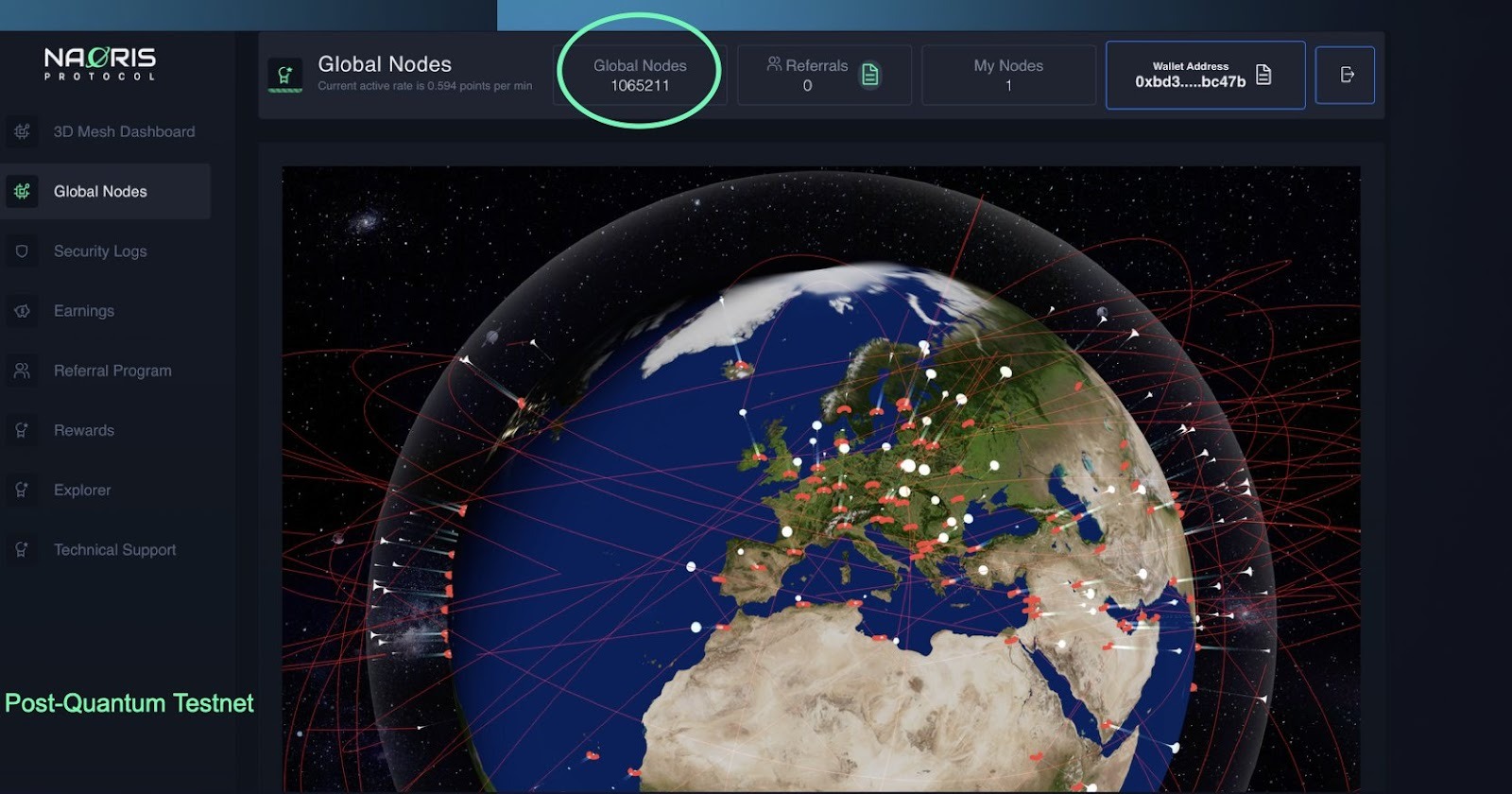
[Image shows the global Testnet trust mesh with nodes distributed worldwide)
In 2025, Naoris significantly expanded the capabilities of its decentralized AI validators, forming a global, decentralized trust mesh that continuously verifies system behavior in real time.
During Testnet, more than 1 million security nodes actively participated in this mesh, collectively detecting and blocking malicious activity at scale. These nodes analyzed threats such as compromised infrastructure, malicious links, abnormal behavior patterns, and coordinated attacks before they could propagate across networks.
Threat intelligence was no longer siloed or centralized. Every new node strengthened the network’s ability to detect, correlate, and respond to threats in real time. As the mesh grew, security improved. Scale became a defensive advantage rather than a vulnerability.
Global Engagement at the Highest Levels
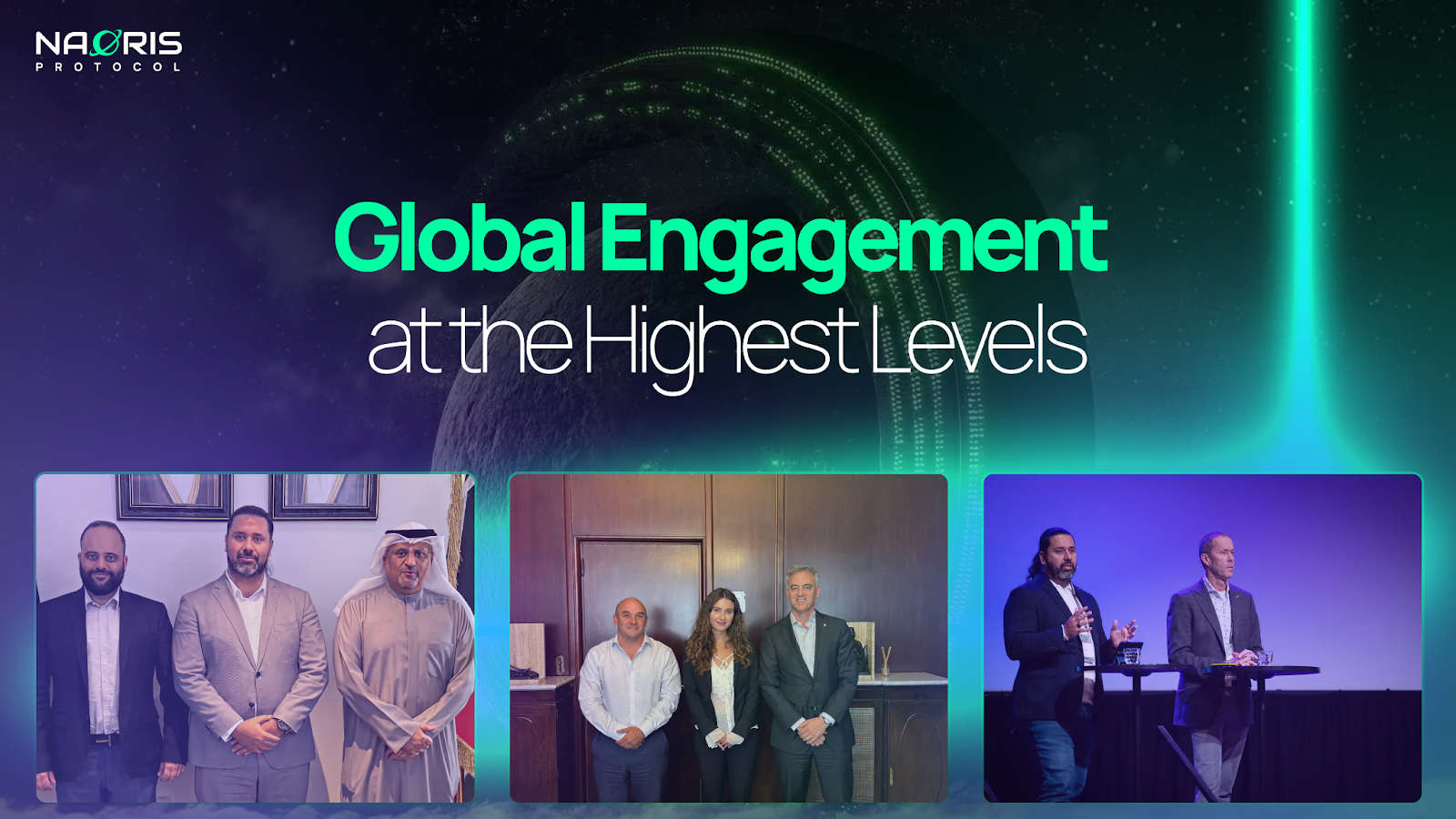
Naoris Protocol’s global footprint expanded rapidly throughout 2025, with engagements spanning governments, regulators, enterprises, and strategic ecosystems across multiple regions.
In Kuwait, Naoris leadership met with His Excellency Omar AlOmar, Minister of State for Communication Affairs, to discuss post-quantum cybersecurity, national resilience, and quantum-ready digital systems. These discussions reflected a growing recognition that quantum security is becoming a national priority.
In Argentina, Naoris held discussions with board members of the Central Bank of Argentina, exploring crypto innovation, digital architecture, and the urgency of quantum-secure systems as global threats accelerate.
At the Norwegian Defence Cryptographic Security Conference, Naoris CEO David Carvalho joined Major General Inge Kampenes, former Chief of the Norwegian Armed Forces Cyber Defence, to outline how state actors are already harvesting encrypted data for future decryption and why early transition to post-quantum standards is critical.
These conversations underscored a clear trend. Quantum readiness is no longer theoretical. It is a strategic imperative.
Ecosystem Presence and Global Events
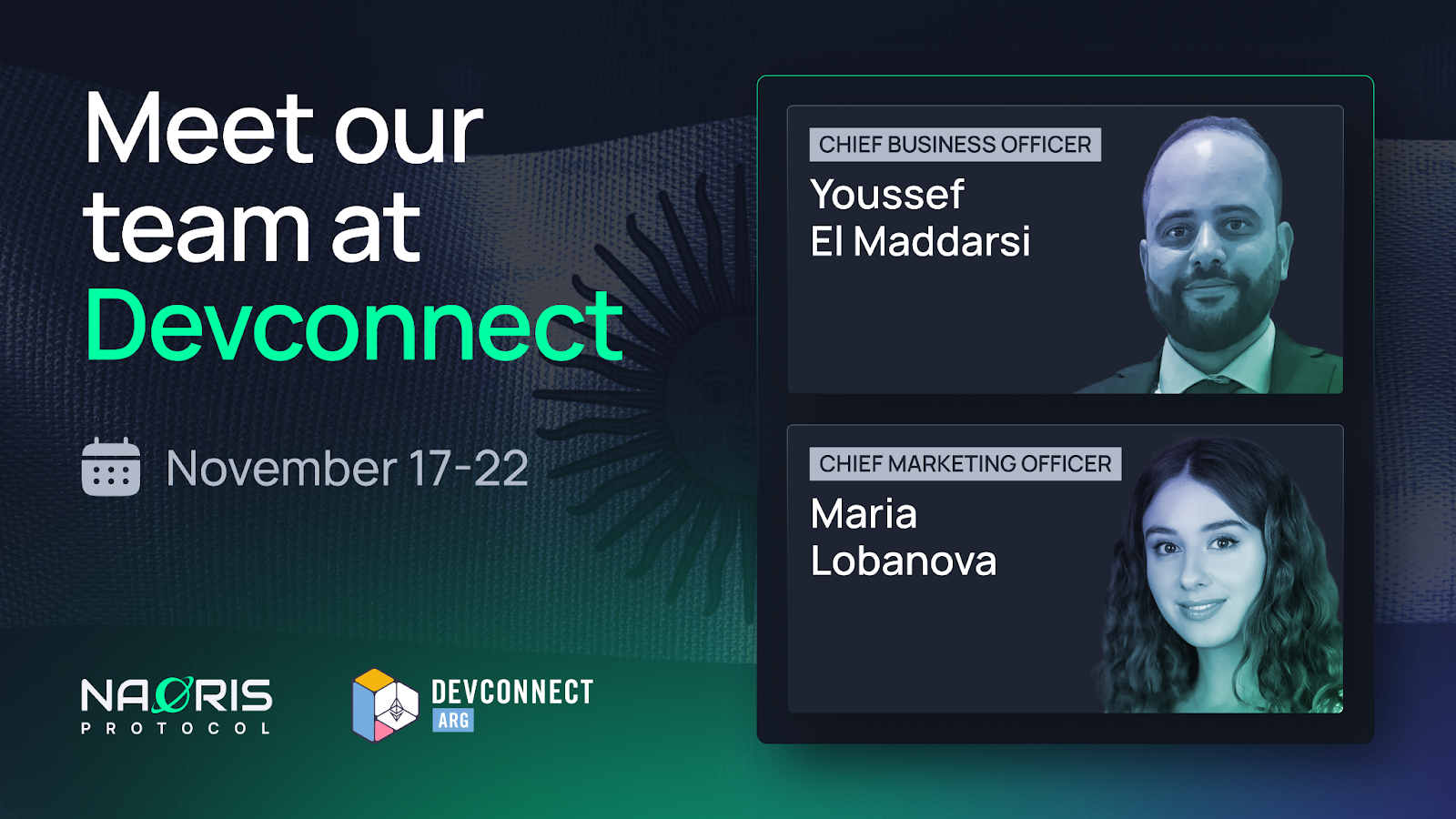
Alongside high-level government engagements, Naoris maintained a strong presence across global Web3, AI, and investment forums.
From Miami to London, Dubai to Buenos Aires, Mexico City to Antigua, Naoris leadership participated in panels, summits, and private forums focused on the future of digital infrastructure, wealth preservation, AI security, and decentralized trust.
Highlights included Art Basel Miami with Nolcha Shows, Blockchain Futurist Conference, Devcon-adjacent events in Buenos Aires, the Global Investors Symposium hosted by the Milken Institute, and the Volcano Innovation Summit in Guatemala.
Across every region, the message was consistent. The world is moving from centralized trust to decentralized security.
The $NAORIS Token and the Security Economy
July 2025 marked the launch of the $NAORIS token, activating the economic layer of the protocol.
$NAORIS enables validator participation, trust scoring, security-economic incentives, and post-quantum verification rewards. It aligns users, enterprises, and validators around continuous security rather than static assumptions.
By the end of Testnet, the network recorded more than 105 million post-quantum transactions, over 600 million threats mitigated, more than 3.3 million wallets, and over 1 million security nodes.
With Testnet sunsetted as part of the transition to Mainnet, $NAORIS entered its next phase of adoption.
$NAORIS is now live and trading across major centralized and decentralized exchanges, expanding access for participants globally and supporting the growth of the network’s security economy as Mainnet approaches.
To learn more about the $NAORIS token, its utility, and where to access it, visit:
https://www.naorisprotocol.com/naoris-token
Capital to Accelerate the Network
In 2025, Naoris Protocol closed a fundraise led by Mason Labs, marking a key milestone in scaling the protocol from research and Testnet validation toward full Mainnet deployment.
The funding supports network expansion, product development, and ecosystem growth, positioning Naoris to deliver decentralized, post-quantum security infrastructure at global scale.
Strategic Partnerships and Ecosystem Growth
In 2025, Naoris expanded its partner ecosystem across AI infrastructure, industrial automation, on-chain reputation, payments, DePIN, and distributed compute.
Key collaborations included Level One Robotics, Precipitate, Stempoints, Facil Pay, Nomis, and Hivello. Each partnership reinforced Naoris Protocol’s role as the security layer beneath emerging digital and physical systems.
Naoris Consulting Nordic led by Inge Kampenes, Former Chief of Norwegian Armed Forces & Chief of Cyber Defence was launched in 2025 too.
Launch of Naoris Ventures
Naoris Protocol also launched Naoris Ventures in 2025, extending its mission to support founders building quantum-ready infrastructure and applications.
Naoris Ventures exists to accelerate innovation at the intersection of security, AI, blockchain, and critical systems, ensuring the next generation of technology is secure by design.
Read More about the launch of Naoris Ventures
A Global Community Driving the Mission
None of this progress happens in isolation.
Throughout 2025, a global community of builders, validators, researchers, operators, and supporters rallied around a shared belief: that trust must become decentralized, continuous, and quantum-ready. Across X, Discord, Telegram, events, Testnet participation, and ecosystem collaborations, thousands of individuals contributed ideas, feedback, validation, and advocacy that helped shape Naoris Protocol’s direction.
Today, that community exceeds 465,000 members worldwide. More importantly, it represents a growing group of people who understand what is coming, why existing security models will not hold, and why building a new foundation of trust matters now.
To everyone who participated, contributed, challenged assumptions, and helped carry this mission forward, thank you. As Naoris moves toward Mainnet, this community remains central to building a quantum safe future.
Looking Ahead to 2026: The Year Security Becomes Infrastructure
If 2025 was the year awareness crystallized, 2026 will be the year action begins.
Quantum computing is no longer a distant concern. Enterprises are reassessing cryptographic assumptions, digital infrastructure is approaching a breaking point, and the conversation has shifted from whether systems need to become quantum-safe to how quickly that transition can happen.
For Naoris Protocol, 2026 marks the move from validation to deployment.
Mainnet is not a finish line. It is the beginning of a new internet architecture.
With Mainnet en route, Naoris Protocol transitions from a controlled validation environment into open participation. Developers, enterprises, institutions, and blockchain ecosystems will be able to connect directly into a decentralized, post-quantum trust network and begin building systems where security is native rather than assumed.
Mainnet opens the door to trust-native infrastructure across a wide range of environments. From APIs and digital signatures to industrial IoT and large-scale data systems, Naoris becomes the foundation for verified systems where every interaction can be continuously validated and mathematically proven secure.
Developers gain full access to the Naoris SDK, enabling them to build on the post-quantum chain, embed post-quantum security into applications, APIs, and AI systems, and connect infrastructure to continuous validation through the decentralized trust mesh.
As Mainnet comes online, the $NAORIS token becomes the core economic engine of the network, powering validation, staking, and reward cycles across millions of participating nodes. Security is no longer static or centralized. It is enforced economically, verified continuously, and strengthened as the network scales.
Mainnet transforms Naoris Protocol into critical infrastructure. An operating system of trust designed for a world entering the quantum era.
Stay safe, stay quantum.
Best, Naoris Team.
About Naoris Protocol
Naoris Protocol is revolutionizing cybersecurity and digital trust with the world’s first Decentralized Post-Quantum Infrastructure, operating at the Sub-Zero Layer, below layers L0 to L3 it secures blockchain transactions and Web3 & Web2 infrastructure, including DEXes, bridges, and validators, enterprise cloud and IoT networks. By transforming every device into a trusted validator node, our Post-Quantum infrastructure leverages the cutting-edge dPoSec consensus and Decentralized Swarm AI, to set a new standard in transparency, trust, and security, preparing Web3 and Web2 for a Post-Quantum future.
Led by industry experts and cyber pioneers adding decades of experience who are committed to advancing the frontiers of cybersecurity and trust, here’s some of our trusted advisors;
- David Holtzman: former CTO of IBM and architect of the DNS protocol
- Ahmed Réda Chami: Ambassador for Morocco to the EU. Former CEO Microsoft North Africa
- Mick Mulvaney: Former White House Chief of Staff
- Inge Kampenes: Former Chief of Norwegian Armed Forces & Chief of Cyber Defence adding decades of experience who are committed to advancing the frontiers of cybersecurity and trust.
Want to learn more?
Visit our Website or check out our White Papers
Stay connected: X | Discord | LinkedIn | Telegram